Understanding Montessori
The Montessori philosophy was developed by Maria Montessori and is based on the belief that children are naturally curious, capable learners who thrive when given freedom, respect, and an environment designed to support their development. At its heart, Montessori believes children thrive when trusted, respected, and given the freedom to become who they are meant to be. Montessori is not simply a teaching method — it is a way of understanding and supporting the whole child.
“The greatest sign of success for a teacher… is to be able to say, ‘The children are now working as if I did not exist.’”
— Maria Montessori
Key Elements of Montessori
Prepared Environments
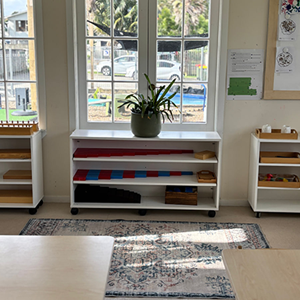
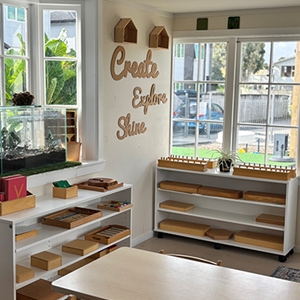
The learning environment is intentionally designed to encourage exploration, independence, and concentration. A Montessori environment is:
- Ordered and calm
- Child-sized and accessible
- Beautiful and purposeful
- Rich in hands-on materials
- Designed for freedom within limits
Children independently choose activities that match their developmental stage.
Sensitive Periods
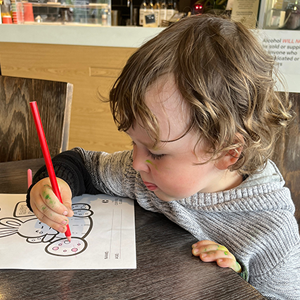
Montessori recognised that children move through periods where they are especially receptive to learning particular skills, such as:
- Language
- Movement
- Order
- Social relationships
- Sensory experiences
Adults observe these periods and provide opportunities that align with the child’s developmental readiness.
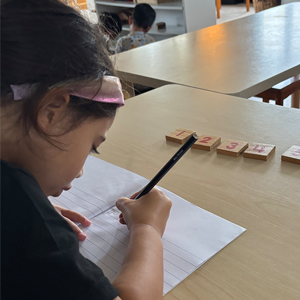
The Whole Child
Montessori supports development across:
- Cognitive growth
- Emotional wellbeing
- Social competence
- Physical development
- Creativity
- Practical life skills
The aim is not only academic success but developing compassionate, capable humans.
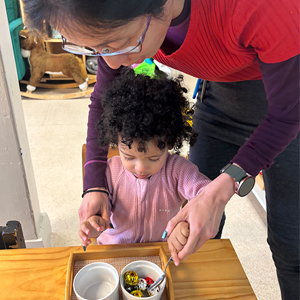
The Role of the Adult
In Montessori, teachers are often called guides rather than instructors. Their role is to:
- Observe carefully
- Prepare the environment
- Introduce materials
- Support without interrupting
- Foster independence
The adult asks:
“What does this child need to thrive?”
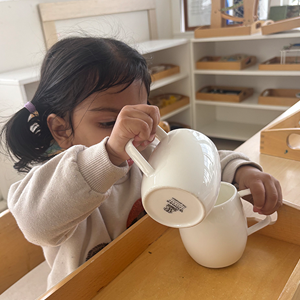
Hands on Learning
Children learn best by doing. Montessori materials are:
- Concrete before abstract
- Self-correcting
- Sequential
- Purposeful
Children experience concepts physically before moving to abstract understanding.
Example:
Touching and counting beads before learning mathematical symbols.
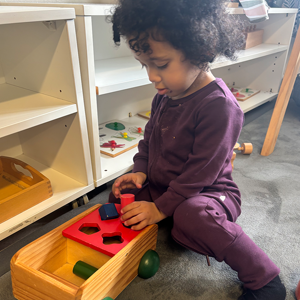
Respect for the Child
Children are viewed as capable individuals with their own thoughts, interests, and pace of development. Adults guide rather than control, fostering independence, confidence, and self-worth.
This means:
- Listening to children
- Offering choices within boundaries
- Allowing time to complete tasks independently
- Supporting rather than doing for the child
The goal: “Help me do it myself.”
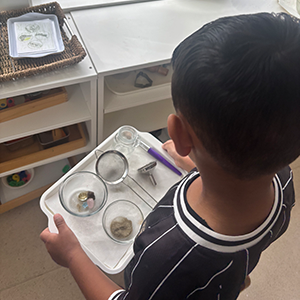
Independence
Montessori nurtures independence from an early age. Children are encouraged to:
- Dress themselves
- Prepare food
- Care for belongings
- Solve problems
- Make decisions
Independence builds:
→ Confidence
→ Responsibility
→ Resilience
→ Intrinsic motivation
Mixed Age Learning
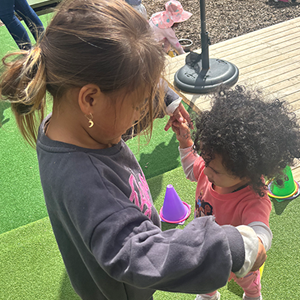
Montessori environments often group children across a three-year age span.
Older children:
- Become leaders and mentors
Younger children:
- Learn through observation and imitation
This creates:
✓ Leadership
✓ Collaboration
✓ Empathy
✓ Community
FAQ About Montessori
Montessori education offers a carefully prepared and purposeful learning environment designed to support each child’s individual development. Learning is child-led, hands-on, and guided through specifically designed materials that enable children to explore concepts concretely before moving towards abstract understanding. Rather than directing learning, Montessori educators observe closely, introduce materials intentionally, and provide support when needed, fostering independence, concentration, and intrinsic motivation.
In comparison, some other educational approaches place greater emphasis on open-ended play, collaborative experiences, and teacher-facilitated group learning, where learning often emerges through social interaction, creativity, and exploration. In these settings, educators may take a more active role in leading experiences and supporting collective learning opportunities.
While approaches differ, Montessori is distinguished by its emphasis on the prepared environment, uninterrupted work periods, mixed-age learning, independence, and respect for each child’s unique developmental pathway.
Yes — children do play within the Montessori philosophy, but Montessori often understands and describes play differently from many conventional early childhood approaches.
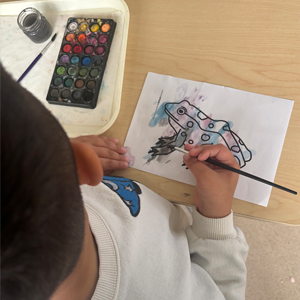
In Montessori, meaningful work and play are not always separated. Activities that adults might view as “work” — pouring water, washing a table, building with geometric solids, caring for plants, preparing food, or exploring language materials — may be deeply engaging and joyful for the child and experienced as play. Montessori recognised that children learn through:
- Exploration and discovery
- Repetition
- Movement
- Hands-on experiences
- Imagination rooted in reality
- Purposeful activity
The philosophy emphasises purposeful activity rather than entertainment-based activities directed by adults. Children may:
- Build with blocks or open-ended materials
- Engage in outdoor exploration and nature play
- Participate in practical life activities (gardening, cooking, cleaning)
- Create art and music
- Engage in social play and conversations
- Explore sensory materials
- Use dramatic or imaginative play, particularly as children grow older
Montessori does not remove play; rather, it sees learning, exploration, and purposeful activity as forms of play and joyful engagement. The aim is not simply to keep children occupied, but to nurture:
✓ Independence
✓ Concentration
✓ Curiosity
✓ Coordination
✓ Responsibility
✓ Joy in learning
At its heart, Montessori believes children thrive when they have the freedom to choose meaningful activity within a carefully prepared environment — and for children, meaningful activity often feels like play.
A common misconception is that Montessori is only for wealthy families or highly academic children. Authentic Montessori aims to support:
- Diverse Learners
- Neurodivergent children
- Different cultural backgrounds
- Children with varying abilities
- Families from all communities
The philosophy centres on equity, dignity, belonging, and respect. Montessori tries to develop and nurture children who are:
✓ Independent
✓ Curious
✓ Respectful
✓ Self-motivated